Uther Fenwickdragon, King of Britain, lusts after Migraine, Duchess of Cornwall, wife of a very minor character. With the aid of magic spellcheckery, Uther disguises himself as a writer and beds Migraine, conceiving a novella, An Aspiration To Lie Flat.
Uther disavows Aspiration until, nearing death without a publication, he claims the book as his own.
After the king expires, Merle tells the Archbishop of Amazon that a miracle is about to occur. He tells him to assemble all the lords and ladies of the land who have ever been known to pay full price for paperbacks.
Then he arranges Aspiration’s unveiling before the international market.
Smuggled away by Merle shortly after creation to save him from Uther’s deleterious wrath, Aspiration has been kept hidden in France by Claude, Duc de Storáge. The Duc must be drawn to London.
Merle creates an incomplete Kindle book listing, inviting every author who aspires to the throne to upload their book and click ‘Submit.’
Etched on the page below the submission button is a warning, “Whoso clicketh this button shall rule as king over an obscure niche genre.”
Many great authors try, but none can make the button click.
Then, Aspiration comes along, in his role as errand boy for someone much more important, and accidentally uploads himself, clicking ‘Submit’ before reading the terms and conditions.
As a result, the genre of modern absurdist fiction is stuck with Aspiration as its ruler.
This is the story’s central tragedy.
Recognized as a true Fenwickdragon after his irresponsible stunt, Aspiration races to seize his rightful Goodreads author page ahead of any rival claimants.
Dispatching all who challenge him with helpful advice, Aspiration perseveres and is crowned “First of release.”
To advance his ambitions, Aspiration weds Hope, second daughter of the Earl of Folly.
From his new father-in-law, he receives a table, precisely large enough to seat every reader he will ever have. Around it, they gather to share their many, many opinions.
To Aspiration’s left, throughout the interminable meetings, sits an empty chair: The Seat Perilous, reserved only for a critic whose heart is pure and good.
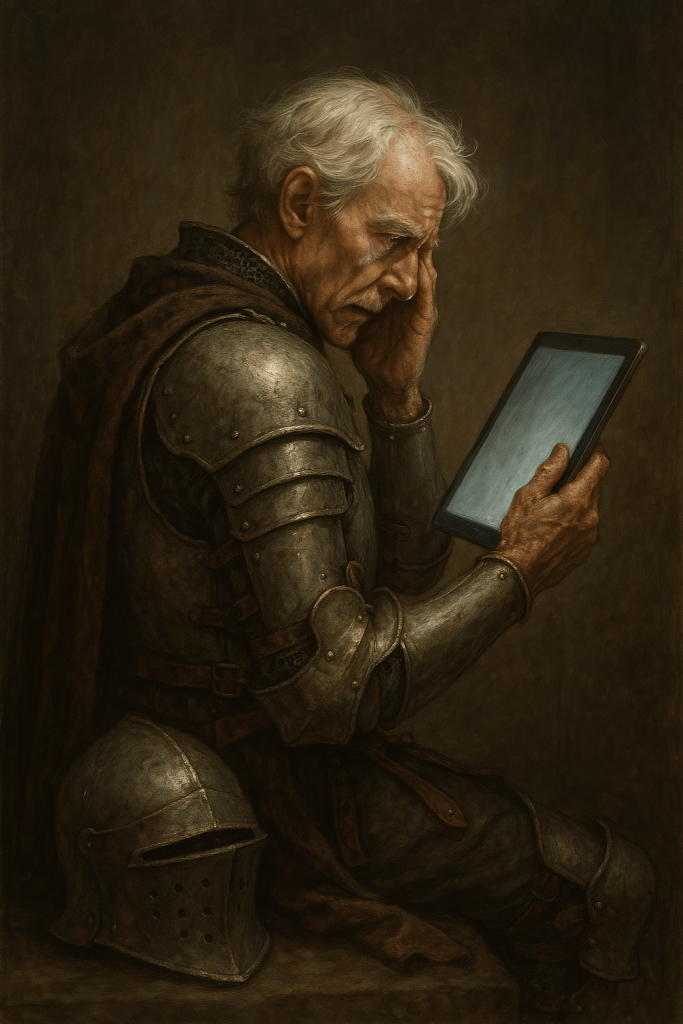
Sure that a great destiny awaits him-and eager to escape the table’s obligations, Aspiration embarks on a Quest for the Holy Five-Star Review.
He overcomes a series of obstacles, principally by offering himself to all who would have him.
Then he finds the Vale of BookSirens, where the reviewers have massed.
Aspiration gains entry and prepares for what awaits.
He knows that, come the morrow, his destiny will be decided on the field of literature. Reviewers will have him surrounded. He sleeps fitfully.
At sunrise, the judgement commences. Aspiration fights bravely, taking few blows in the early going.
Then a user named Morgan the Overfamiliar leaves a one-star review, piercing Aspiration’s heart.
“It has all been done before,” she writes, “by much more talented people.”
The blow proves mortal to Aspiration’s marketability. He falls where he stands, in the rankings.
As he lies dying, Aspiration’s final request is that his beloved sword ‘Experience’ be returned to the pool of forgotten literature, where dwells his only fan.
Then, Aspiration is no more.
Duty-bound to the last, Sir Kindle carries Aspiration’s treasured ‘Experience’ to the pond’s edge. With a powerful swing, he casts it deep into the murky water, where it disappears without comment or like.
Shrugging, Sir Kindle withdraws.
Thus ends the House of Fenwickdragon.



 Stanton Fenwick